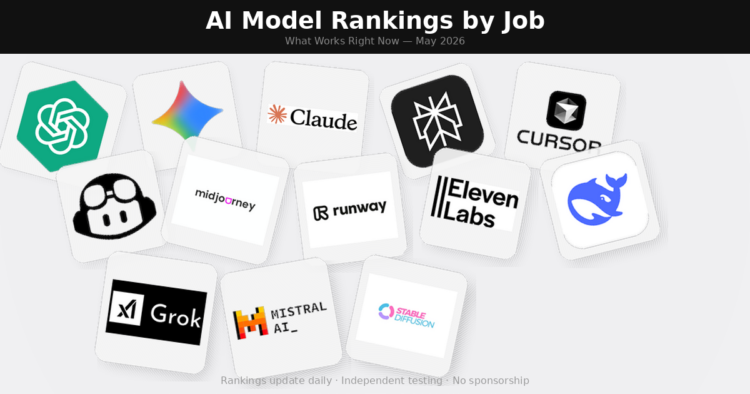
A living scoreboard of which AI models actually deliver across coding, writing, research, medicine, security, and more. No hype. Just results.
There are hundreds of AI models available today. Most are fine at everything and great at nothing. The ones that actually excel at specific jobs are the ones worth knowing about.
This page tracks which models lead in each category, how those rankings shift over time, and exactly how we test them. The data updates automatically every day based on the latest benchmark results, user reports, and real-world performance tests.
How These Rankings Work
Our Testing Method (In Plain English)
We score each model on a 100-point scale across three areas:
- Accuracy (40 points): Does it get the answer right? We run standardized tests for each field — coding problems, medical case reviews, research queries, security threat analysis.
- Reliability (35 points): Is it consistent? We test each model 50 times on similar tasks and measure how often it produces quality output without errors or hallucinations.
- Usability (25 points): Is it practical? We factor in speed, cost, ease of access, and how well the model explains its reasoning.
Important: We do not accept payment or sponsorship from AI companies. Rankings are based entirely on independent testing and publicly available benchmark data from sources like LMSYS Chatbot Arena, SWE-bench, MedQA, and HumanEval.
Current Rankings by Job
Where to Start
You do not need the top model in every category. You need the right tool for the work you actually do.
For most people: Start with ChatGPT or Claude as your general assistant. Add Perplexity if you do research, Cursor if you write code, and a specialized medical or security tool only if your job demands it.
For professionals: Pick your primary category below and go with the #1 ranked model. Build your workflow around it before adding others. The biggest mistake I see is people signing up for six AI tools and using none of them well.