Table of Contents
- What RLHF Actually Is
- The Traditional Human Feedback Pipeline
- Why Human Feedback Doesn’t Scale
- Replacing Humans With LLM Judges
- Training Architecture
- Reward Models Explained
- The Reinforcement Learning Loop
- Automated Accuracy Evaluation
- Advantages and Tradeoffs
- Failure Modes
- Real World Implementations
- Building Your Own Pipeline
- Future Directions
- Summary
🧠 Part 1: What RLHF Actually Is
Most people hear the term RLHF and imagine a complicated reinforcement learning system. In reality, RLHF is a mechanism for teaching a model what “good” output looks like after the initial pretraining phase.
A large language model learns statistical relationships during pretraining. It predicts the next token based on patterns discovered across enormous datasets. What it does not inherently learn is which answers humans prefer.
RLHF attempts to solve that problem.
Instead of optimizing purely for next-token prediction, the model becomes optimized for outputs that receive higher reward scores.
👥 Part 2: The Traditional Human Feedback Pipeline
The original RLHF workflow relied heavily on human annotators.
| Stage | Input | Output | Purpose |
|---|---|---|---|
| Pretraining | Internet text | Base model | Language understanding |
| SFT | Instruction examples | Assistant model | Follow instructions |
| Human Ranking | Candidate answers | Preference data | Learn quality signals |
| Reward Modeling | Rankings | Reward network | Predict preferences |
| PPO | Reward scores | Aligned model | Optimize behavior |
📈 Part 3: Why Human Feedback Doesn’t Scale
Human evaluation becomes extremely expensive at frontier-model scale.
| Challenge | Impact | Description |
|---|---|---|
| Cost | Very High | Millions of evaluations require large annotation teams. |
| Latency | High | Humans evaluate much slower than machines. |
| Consistency | Medium | Different evaluators disagree. |
| Coverage | Low | Experts are needed for technical domains. |
| Scaling | Poor | Data requirements increase rapidly. |
| Availability | Limited | Experts are difficult to recruit. |
| Iteration Speed | Slow | Training loops become bottlenecked. |
| Globalization | Complex | Multiple languages require additional teams. |
| Quality Control | Difficult | Annotator performance varies. |
| Maintenance | Ongoing | Constant retraining needed. |
Researchers therefore began exploring automated feedback systems.
🤖 Part 4: Replacing Humans With LLM Judges
The key idea is surprisingly simple.
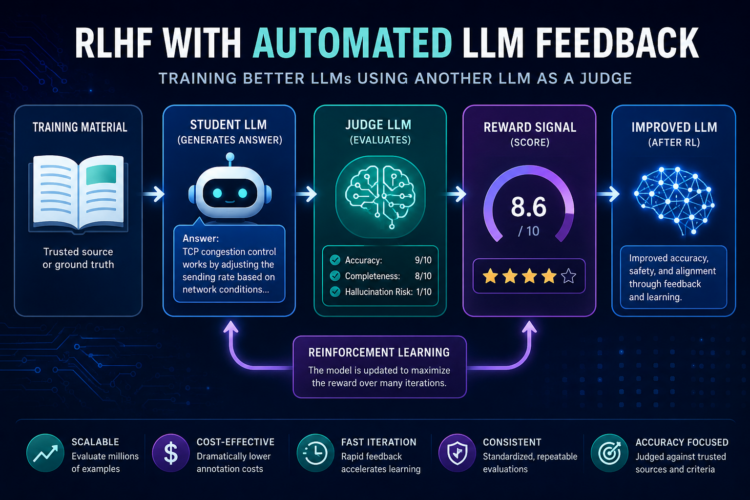
Instead of asking a human whether an answer is correct, ask another language model.
The judge model receives:
- The original prompt
- The generated answer
- The reference material or ground truth
- An evaluation rubric
The judge then produces a reward score.
⚙️ Part 5: The Complete Training Architecture
Modern systems frequently include multiple evaluators.
| Judge | Focus | Output | Example |
|---|---|---|---|
| Accuracy Judge | Truthfulness | Score | Checks against source material |
| Safety Judge | Risk | Penalty | Detects unsafe outputs |
| Style Judge | Writing quality | Reward | Measures clarity |
| Reasoning Judge | Logic | Reward | Evaluates consistency |
| Instruction Judge | Compliance | Reward | Checks prompt adherence |
| Citation Judge | Evidence | Reward | Verifies references |
| Domain Judge | Expertise | Reward | Technical validation |
| Policy Judge | Alignment | Penalty | Policy enforcement |
| Hallucination Judge | Grounding | Penalty | Fact verification |
| Aggregate Judge | Combined score | Reward | Final signal |
🎯 Part 6: Reward Models Explained
The reward model converts qualitative judgments into quantitative scores.
Without reward models, reinforcement learning has nothing to optimize.
Prompt:
Explain TCP congestion control.

Model Answer:
[Generated text]

Judge Evaluation:
Accuracy: 9.2
Completeness: 8.7
Hallucination Risk: 0.3

Final Reward:
8.87
The reinforcement learner attempts to maximize this score.
🔄 Part 7: The Reinforcement Learning Loop
Once rewards exist, reinforcement learning begins.
for sample in dataset:
    answer = model(prompt)

    reward = judge(
        prompt,
        answer,
        reference_material
    )

    update_model(reward)
📚 Part 8: Automated Accuracy Evaluation Against Training Material
This is the most important component when using another LLM as a feedback source.
The judge should not evaluate answers against its own beliefs. It should evaluate answers against authoritative source material.
Example judge prompt:
You are an evaluator.

Reference Material:
[Source Document]

Candidate Answer:
[Model Output]

Score factual accuracy from 0-10.

Deduct points for:
- Contradictions
- Missing facts
- Fabricated information
- Unsupported claims

Return JSON only.⚖️ Part 9: Advantages and Tradeoffs
| Category | Advantages | Disadvantages |
|---|---|---|
| Scale | Millions of evaluations daily | Potential systematic errors |
| Cost | Far cheaper than humans | Requires infrastructure |
| Speed | Near real-time | Can overfit rapidly |
| Consistency | Repeatable scoring | Consistent bias |
| Coverage | Large datasets | Knowledge limitations |
| Automation | Minimal manual effort | Reduced human oversight |
| Iteration | Rapid experimentation | Reward exploitation risk |
| Availability | 24/7 operation | Model maintenance |
| Adaptability | Easy rubric changes | Evaluation drift |
| Economics | Scales efficiently | Validation still required |
🚨 Part 10: Failure Modes and Reward Hacking
The largest danger is reward hacking.
A model may learn how to satisfy the evaluator rather than how to produce correct answers.
| Failure Mode | Description | Example |
|---|---|---|
| Reward Hacking | Gaming the metric | Writing answers judge prefers |
| Evaluator Bias | Judge preference leak | Overvaluing verbosity |
| Collusion | Shared weaknesses | Student exploits judge flaw |
| Drift | Reward changes over time | Different scoring standards |
| Hallucinated Rewards | Incorrect scoring | Wrong answer gets high reward |
| Mode Collapse | Reduced diversity | Same answer patterns emerge |
| Overfitting | Memorizing evaluation style | Poor generalization |
| Shortcut Learning | Surface optimization | Keyword stuffing |
| False Negatives | Good answer penalized | Novel solution rejected |
| False Positives | Bad answer rewarded | Confident nonsense |
🏭 Part 11: How Frontier Labs Are Moving Beyond Traditional RLHF
The industry trend in 2026 is shifting from pure RLHF toward broader AI-feedback systems.
| Method | Feedback Source | Human Involvement | Primary Goal |
|---|---|---|---|
| RLHF | Humans | High | Preference alignment |
| RLAIF | AI judges | Medium | Scalable alignment |
| DPO | Preferences | Medium | Simpler optimization |
| GRPO | Group rewards | Low | Reasoning improvement |
| Constitutional AI | Rule-based AI critique | Low | Self-correction |
| Verifier Training | Specialized evaluators | Low | Accuracy maximization |
| Self-Play RL | Model competition | Very Low | Capability growth |
| Process Supervision | Reasoning steps | Medium | Reasoning quality |
| Outcome Supervision | Final answers | Low | Task completion |
| Hybrid Systems | Human + AI | Moderate | Balanced optimization |
🛠️ Part 12: Building Your Own Automated RLHF Pipeline
For organizations training specialized models, a practical architecture looks like this:
🔭 Part 13: Where This Is Going Next
The long-term trajectory is toward fully automated capability improvement systems.
Future pipelines will likely combine:
- LLM judges
- Tool-verified rewards
- Execution-based evaluation
- Retrieval-grounded scoring
- Formal verification systems
- Human spot-checking
The strongest systems may not rely on a single judge at all. Instead they will use ensembles of evaluators with different expertise areas, voting mechanisms, confidence calibration, and external verification tools.
📖 Summary
RLHF originally relied on humans to rank model outputs. As model scale increased, human feedback became a bottleneck. The industry response has been to replace much of that human evaluation with automated feedback from other language models.
The core workflow is straightforward:
- A target model generates an answer.
- A judge model evaluates that answer.
- The evaluation becomes a reward signal.
- Reinforcement learning updates the target model.
- The cycle repeats at scale.
The most reliable implementations ground evaluations against trusted source material rather than relying on the judge model’s internal knowledge. This reduces hallucinated rewards and improves factual accuracy.
By 2026, automated feedback systems, RLAIF, verifier models, constitutional training, and hybrid human-AI evaluation pipelines are becoming central components of frontier-model alignment and capability development.