PyTorch and Large Language Models: A Complete Guide to Understanding the Code and Building an LLM from Scratch (2026 Edition)

🚀 Part 1 — What PyTorch Actually Is

PyTorch is a machine learning framework developed originally by Facebook AI Research and now maintained by a large open-source community.

At its core, PyTorch provides:

  • Tensor operations
  • Automatic differentiation
  • GPU acceleration
  • Neural network abstractions
  • Distributed training tools
  • Inference optimization
💡 The Simple Version

PyTorch is essentially a very powerful mathematics engine that can automatically learn patterns from data.

Raw Data ↓ Tensor Operations ↓ Neural Network ↓ Loss Function ↓ Backpropagation ↓ Updated Weights ↓ Better Predictions

📦 Part 2 — Understanding Tensors

Everything in PyTorch is a tensor.

Object Dimensions Example Meaning
Scalar0D5Single value
Vector1D[1,2,3]List
Matrix2D[[1,2],[3,4]]Table
Tensor3D+Batch DataMulti-dimensional structure
import torch

x = torch.tensor([1, 2, 3])
print(x)

y = x * 2
print(y)

PyTorch tensors can run on CPUs or GPUs with almost identical code.

device = "cuda" if torch.cuda.is_available() else "cpu"

x = torch.tensor([1,2,3]).to(device)

🧠 Part 3 — Automatic Differentiation

The most important feature in PyTorch is Autograd.

Instead of manually computing derivatives, PyTorch builds a computation graph and computes gradients automatically.

import torch

x = torch.tensor(2.0, requires_grad=True)

y = x ** 2

y.backward()

print(x.grad)

Output:

tensor(4.)
🧠 Why This Matters

Every LLM containing billions of parameters is trained through repeated gradient calculations. Without automatic differentiation, modern AI would be practically impossible.

🏗️ Part 4 — Neural Networks in PyTorch

PyTorch’s nn.Module is the foundation of deep learning models.

import torch.nn as nn

class SimpleNetwork(nn.Module):
    def __init__(self):
        super().__init__()

        self.layer1 = nn.Linear(10,64)
        self.layer2 = nn.Linear(64,1)

    def forward(self,x):
        x = self.layer1(x)
        x = torch.relu(x)
        x = self.layer2(x)
        return x
Input ↓ Linear Layer ↓ Activation ↓ Linear Layer ↓ Prediction

⚙️ Part 5 — The Training Loop

Every deep learning system follows the same cycle.

1
Load data into memory.
2
Perform a forward pass.
3
Compute loss.
4
Run backpropagation.
5
Update parameters.
for batch in dataloader:

    optimizer.zero_grad()

    predictions = model(batch)

    loss = criterion(predictions, labels)

    loss.backward()

    optimizer.step()

🔤 Part 6 — Tokenization

LLMs do not understand words. They understand tokens.

Text Tokenized IDs Meaning
Hello World Hello + World 1523, 4211 Vocabulary references
Artificial Intelligence Artificial + Intelligence 842, 1094 Subword tokens
PyTorch Py + Torch 119, 822 Byte Pair Encoding
📖 The Simple Version

Tokenization converts human language into numbers.

🔢 Part 7 — Embeddings

Embeddings transform token IDs into dense vectors.

embedding = nn.Embedding(
    num_embeddings=50000,
    embedding_dim=768
)

output = embedding(token_ids)
Token ID ↓ Embedding Layer ↓ 768 Numbers ↓ Semantic Meaning

🎯 Part 8 — Attention Explained

Attention is the breakthrough that enabled modern LLMs.

💡 The Simple Version

Attention allows a word to look at other words in the sequence and determine which ones matter.

The famous transformer equation:

Attention(Q,K,V) =
softmax(
QKᵀ / √d
)V
Component Meaning Role Output
QQueryWhat am I looking for?Search signal
KKeyWhat information exists?Lookup signalMatching score
VValueActual contentReturned dataContext vector

🏛️ Part 9 — The Transformer Architecture

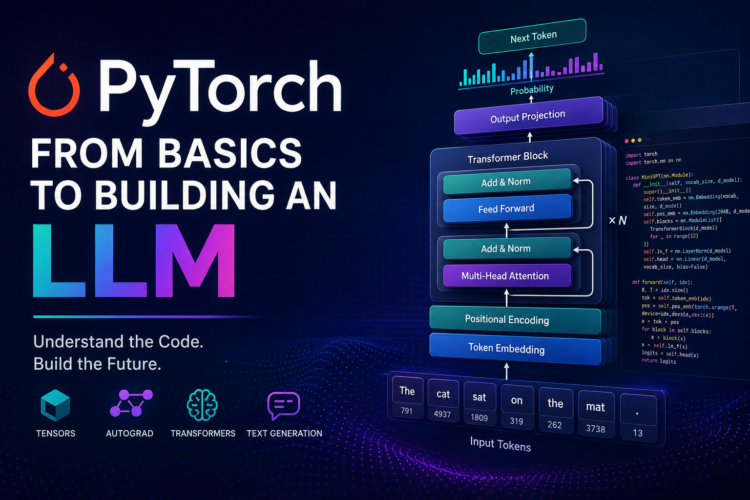
Input Tokens ↓ Embeddings ↓ Positional Encoding ↓ Transformer Block ↓ Transformer Block ↓ Transformer Block ↓ Output Projection ↓ Next Token Prediction

Modern GPT-style models are essentially stacks of transformer blocks.

class TransformerBlock(nn.Module):

    def __init__(self):
        super().__init__()

        self.attention = MultiHeadAttention()
        self.feedforward = FeedForward()

    def forward(self,x):
        x = self.attention(x)
        x = self.feedforward(x)
        return x

🏗️ Part 10 — Building an LLM in PyTorch

A minimal GPT-style model contains:

Layer Purpose Input Output
EmbeddingToken vectorsIDsVectors
Position EmbeddingOrder awarenessPositionsVectors
AttentionContextVectorsContext vectors
Feed ForwardReasoningVectorsEnhanced vectors
Output HeadPredictionVectorsVocabulary logits
class MiniGPT(nn.Module):

    def __init__(
        self,
        vocab_size,
        embed_dim
    ):
        super().__init__()

        self.embedding = nn.Embedding(
            vocab_size,
            embed_dim
        )

        self.transformer = TransformerBlock()

        self.output = nn.Linear(
            embed_dim,
            vocab_size
        )

    def forward(self,x):

        x = self.embedding(x)

        x = self.transformer(x)

        logits = self.output(x)

        return logits

📚 Part 11 — Training an LLM

Training data is converted into sequences.

Input:
"The cat sat on"

Target:
"cat sat on the"

The model learns to predict the next token repeatedly.

Token 1 → Predict Token 2 Token 2 → Predict Token 3 Token 3 → Predict Token 4 Token 4 → Predict Token 5
⚠️ Reality Check

Training even a relatively small LLM requires significant compute resources, large datasets, careful hyperparameter tuning, monitoring, checkpointing, evaluation pipelines, and distributed GPU infrastructure.

🔮 Part 12 — Inference and Text Generation

After training, the model generates text token by token.

while not done:

    logits = model(tokens)

    next_token = sample(logits)

    tokens.append(next_token)
Method Quality Creativity Speed
GreedyMediumLowFast
Top-KHighMediumFast
Top-PHighHighMedium
Beam SearchVery HighLowSlow

📈 Part 13 — Scaling to Modern LLMs

Model Parameters Architecture Context Era
GPT-21.5BTransformer10242019
GPT-3175BTransformer20482020
LLaMA7B-70B+Transformer4k+2023+
Modern ModelsHundreds of Billions+Transformer Variants100k+2026

Scaling generally involves:

  • More parameters
  • More data
  • Longer context windows
  • More GPUs
  • Better optimizers
  • Improved architectures

🧰 Part 14 — Essential PyTorch Ecosystem Tools

Tool Purpose Importance Used For Category
PyTorchCore frameworkCriticalTrainingFoundation
TorchVisionVisionHighImagesCV
TorchAudioAudioHighSpeechAudio
TransformersPretrained modelsCriticalLLMsNLP
DatasetsData loadingHighTrainingData
AccelerateDistributed trainingHighScalingInfrastructure
DeepSpeedLarge-scale optimizationCriticalMassive LLMsScaling
TensorBoardMonitoringHighMetricsObservability

🎯 Summary

🔑 Key Takeaways
  • Everything in PyTorch starts with tensors.
  • Autograd powers backpropagation.
  • Neural networks are built from layers.
  • Transformers are stacks of attention and feed-forward blocks.
  • Tokenization converts language into numbers.
  • Embeddings create semantic meaning.
  • Attention provides contextual understanding.
  • Training teaches next-token prediction.
  • Inference generates tokens sequentially.
  • Modern LLMs are scaled transformer systems built on these same fundamentals.

The most important realization is that modern AI systems are not magic. Every GPT-style model ultimately consists of matrix multiplications, gradient updates, attention mechanisms, optimization loops, and massive amounts of data. PyTorch provides the tools to build every layer of that stack, from a simple neural network running on a laptop to distributed transformer training across thousands of GPUs.

“`
Author: Jon-Paul Walton