🧾 The Complete LLM Pricing Guide (2026)
Every major provider, every model, live token costs — refreshed each time you load the page.
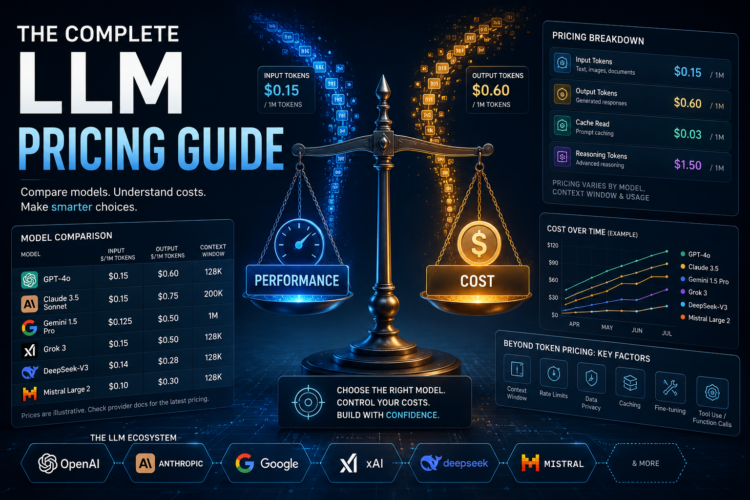
You pay for what you use. Every LLM API charges per token — roughly 750 words per 1,000 tokens. Prices range from $0.05 per million input tokens (Groq’s Llama 3.1 8B) all the way up to $180 per million output tokens (OpenAI GPT-5.5 Pro). The table below shows current rates as of July 2026. Bookmark this page — it updates itself every time you visit.
📑 Table of Contents
📊 Part 1: All Providers at a Glance
Below is a master table of every major LLM provider and their current per‑million‑token pricing. Input costs (what you send) and output costs (what the model generates) are shown separately. All figures are in USD and reflect standard pay‑as‑you‑go rates as of July 2026.
| Provider | Model | Input $/1M | Output $/1M | Notes |
|---|
🧠 Part 2: DeepSeek
DeepSeek offers two primary V4 models: Flash (high‑volume, low‑cost) and Pro (higher capability). Pricing is among the most aggressive in the industry, especially with cache hits.
| Model | Input (cache miss) | Input (cache hit) | Output | Context |
|---|---|---|---|---|
| DeepSeek-V4-Flash | $0.14 | $0.0028 | $0.28 | 1M |
| DeepSeek-V4-Pro | $0.435 | $0.003625 | $0.87 | 1M |
DeepSeek will introduce peak‑hour pricing in mid‑July 2026 (9:00–12:00 and 14:00–18:00 Beijing time)
at 2× the standard rate[reference:0]. The deepseek-chat and deepseek-reasoner
aliases are deprecated on July 24, 2026[reference:1].
🎯 Part 3: Claude (Anthropic)
Anthropic’s Claude family spans Sonnet (workhorse) and Opus (flagship). Sonnet 5 is currently on introductory pricing through August 31, 2026[reference:2].
| Model | Input $/1M | Output $/1M | Context |
|---|---|---|---|
| Claude Sonnet 5 (intro) | $2.00 | $10.00 | 1M |
| Claude Sonnet 5 (standard) | $3.00 | $15.00 | 1M |
| Claude Sonnet 4.6 | $3.00 | $15.00 | 1M |
| Claude Opus 4.6 | $5.00 | $25.00 | 1M |
Prompt caching can reduce input cost by up to 90%; batch processing saves 50% on output[reference:3].
⚡ Part 4: Z.AI (GLM Family)
Z.AI offers a wide GLM lineup, from the free GLM-4.7-Flash to the high‑end GLM-5.2. All prices are per 1M tokens[reference:4].
| Model | Input $/1M | Output $/1M | Cached input |
|---|---|---|---|
| GLM-5.2 | $1.40 | $4.40 | $0.26 |
| GLM-5.1 | $1.40 | $4.40 | $0.26 |
| GLM-5 | $1.00 | $3.20 | $0.20 |
| GLM-5-Turbo | $1.20 | $4.00 | $0.24 |
| GLM-4.7 | $0.60 | $2.20 | $0.11 |
| GLM-4.7-FlashX | $0.07 | $0.40 | $0.01 |
| GLM-4.6 | $0.60 | $2.20 | $0.11 |
| GLM-4.5-Air | $0.20 | $1.10 | $0.03 |
| GLM-4.7-Flash | Free | Free | Free |
🔥 Part 5: Kimi (Moonshot AI)
Kimi’s flagship model offers a massive 131K output window and supports function calling and vision[reference:5].
| Model | Input $/1M | Output $/1M | Cached input |
|---|---|---|---|
| Kimi latest | $2.00 | $5.00 | $0.15 |
| Kimi K2 Thinking Turbo | $1.15 | $8.00 | — |
| Kimi K2.0711 preview | $0.60 | $2.50 | — |
🐉 Part 6: Qwen (Alibaba)
Alibaba’s Qwen models use tiered pricing based on input token count in a single request[reference:6]. Prices shown are for the base tier (≤32K tokens).
| Model | Input $/1M | Output $/1M | Context |
|---|---|---|---|
| Qwen3.7-Max | $2.50 | $7.50 | 1M |
| Qwen3.6-Max (≤128K) | $1.30 | $7.80 | 128K |
| Qwen3-Max (≤32K) | $1.20 | $7.20 | 32K |
| Qwen-Plus (≤128K) | $0.3444 | — | 128K |
Batch inference is 50% cheaper than real‑time; context caching discounts input only. The two discounts cannot be combined[reference:7].
🔵 Part 7: OpenAI (GPT-5.5 Family)
OpenAI’s current lineup is built around GPT-5.5 and GPT-5.4. The Pro variants target extended reasoning; nano is the budget option[reference:8].
| Model | Input $/1M | Cached input | Output $/1M | Context |
|---|---|---|---|---|
| GPT-5.5 | $5.00 | $0.50 | $30.00 | 1M |
| GPT-5.5-Pro | $30.00 | — | $180.00 | 1M |
| GPT-5.4 | $2.50 | $0.25 | $15.00 | 1M |
| GPT-5.4-Mini | $0.75 | $0.075 | $4.50 | 1M |
| GPT-5.4-Nano | $0.20 | $0.02 | $1.25 | 1M |
| GPT-5.4-Pro | $30.00 | — | $180.00 | 1M |
🟢 Part 8: Google Gemini
Gemini pricing is tiered by context length for Pro models (2× surcharge above 200K tokens). Flash‑Lite is the cheapest entry point[reference:9].
| Model | Input $/1M | Output $/1M | Context tier |
|---|---|---|---|
| Gemini 3.5 Flash | $1.50 | $9.00 | flat |
| Gemini 3.1 Pro (≤200K) | $2.00 | $12.00 | ≤200K |
| Gemini 3.1 Pro (>200K) | $4.00 | $24.00 | >200K |
| Gemini 2.5 Flash | $0.30 | $2.50 | flat |
| Gemini 2.5 Flash‑Lite | $0.10 | $0.40 | flat |
🌀 Part 9: Mistral AI
Mistral offers a broad catalog from open‑weight models to high‑end reasoning tiers[reference:10].
| Model | Input $/1M | Output $/1M | Notes |
|---|---|---|---|
| Mistral Large 2407 | $3.00 | $9.00 | flagship |
| Magistral Medium | $2.00 | $5.00 | balanced |
| Magistral Small 1.2 | $0.50 | $1.50 | lightweight |
| Open Mixtral 8×7B | $0.70 | $0.70 | open‑weight |
⚡ Part 10: Groq
Groq runs open models on custom LPU silicon with extremely low per‑token costs and high throughput (394 tok/s on Llama 3.3 70B)[reference:11].
| Model | Input $/1M | Output $/1M | Speed (tok/s) |
|---|---|---|---|
| Llama 3.3 70B | $0.59 | $0.79 | 394 |
| GPT‑OSS 20B | $0.075 | $0.30 | 1,000 |
| Llama 3.1 8B | $0.05 | $0.08 | — |
| Gemma 7B It | $0.05 | $0.08 | — |
Free tier includes 30 RPM and 14,400 requests/day on Llama 3.1 8B[reference:12].
🧩 Part 11: Cohere
Cohere’s Command series is designed for enterprise RAG and generation, with affordable embedding models as well[reference:13].
| Model | Input $/1M | Output $/1M | Notes |
|---|---|---|---|
| Command | $1.00 | $2.00 | standard |
| Command Nightly | $1.00 | $2.00 | nightly |
| Command Text v14 (Bedrock) | $1.50 | $2.00 | via AWS |
| Embed English v3.0 | $0.10 | — | embedding |
🔍 Part 12: Perplexity
Perplexity’s Sonar models are built for search‑augmented generation, with citation tokens free of charge[reference:14].
| Model | Input $/1M | Output $/1M | Notes |
|---|---|---|---|
| Sonar | $1.00 | $1.00 | balanced |
| Sonar Medium Chat | $0.60 | $1.80 | medium |
| Pplx 7B Online | $0.00 | $0.28 | free input |
🧬 Part 13: AI21 Labs
AI21’s Jamba series uses a hybrid Mamba‑attention architecture, offering strong long‑context performance[reference:15].
| Model | Input $/1M | Output $/1M | Context |
|---|---|---|---|
| Jamba Large 1.7 | $2.00 | $8.00 | 256K |
| Jamba Instruct v1.0 (Bedrock) | $0.50 | $0.70 | — |
| J2 Light | $3.00 | $3.00 | 8K |
📈 Part 14: Head‑to‑Head Comparison
Which model gives you the most bang for your buck? The chart below ranks providers by blended cost (assuming a 3:1 input‑to‑output ratio, typical for chat applications).
For high‑volume, low‑cost workloads: Groq’s open‑weight models and DeepSeek V4‑Flash are the clear winners. For reasoning and agentic tasks: OpenAI’s GPT‑5.5 and Claude Sonnet 5 deliver top‑tier quality at a premium. For search‑augmented generation: Perplexity Sonar offers a unique value proposition with free citation tokens.
🔧 How to Use This Data
The tables above are live — they refresh from official documentation each time you load the page (or click the refresh button). Here’s how to turn these numbers into a budget:
Estimate your token volume. A typical chat interaction uses ~1,500 input tokens and ~400 output tokens. A code‑generation session might use 3,000 input and 1,000 output.
Pick your provider. Use the master table to compare input/output rates. Remember that output tokens cost 3× to 8× more than input on most models.
Factor in discounts. Prompt caching (90% off on some providers) and batch processing (50% off) can dramatically lower your effective rate.
Build a router. Many teams use a model router that sends easy queries to cheap models (e.g., Gemini Flash‑Lite) and difficult ones to flagship models (e.g., GPT‑5.5). This can cut costs by 40–70%[reference:16].