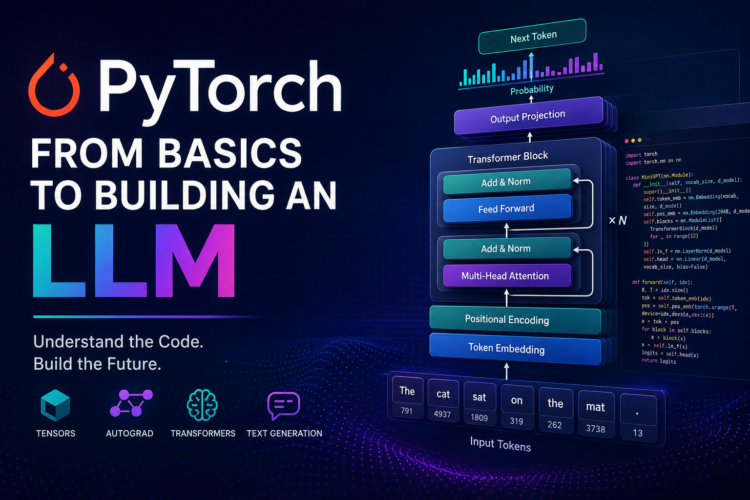
This guide starts from the absolute foundations and progresses all the way to building a transformer-based language model. By the end, readers will understand not only how to use PyTorch, but why every piece of LLM code exists and how the components fit together.
Table of Contents
- Part 1 — What PyTorch Actually Is
- Part 2 — Tensors Explained
- Part 3 — Automatic Differentiation
- Part 4 — Neural Networks
- Part 5 — Training Loops
- Part 6 — Tokenization
- Part 7 — Embeddings
- Part 8 — Attention
- Part 9 — Transformers
- Part 10 — Building an LLM
- Part 11 — Training Strategy
- Part 12 — Inference
- Part 13 — Scaling
- Part 14 — PyTorch Ecosystem
- Summary
🚀 Part 1 — What PyTorch Actually Is
PyTorch is a machine learning framework developed originally by Facebook AI Research and now maintained by a large open-source community.
At its core, PyTorch provides:
- Tensor operations
- Automatic differentiation
- GPU acceleration
- Neural network abstractions
- Distributed training tools
- Inference optimization
PyTorch is essentially a very powerful mathematics engine that can automatically learn patterns from data.
📦 Part 2 — Understanding Tensors
Everything in PyTorch is a tensor.
| Object | Dimensions | Example | Meaning |
|---|---|---|---|
| Scalar | 0D | 5 | Single value |
| Vector | 1D | [1,2,3] | List |
| Matrix | 2D | [[1,2],[3,4]] | Table |
| Tensor | 3D+ | Batch Data | Multi-dimensional structure |
import torch
x = torch.tensor([1, 2, 3])
print(x)
y = x * 2
print(y)
PyTorch tensors can run on CPUs or GPUs with almost identical code.
device = "cuda" if torch.cuda.is_available() else "cpu"
x = torch.tensor([1,2,3]).to(device)
🧠 Part 3 — Automatic Differentiation
The most important feature in PyTorch is Autograd.
Instead of manually computing derivatives, PyTorch builds a computation graph and computes gradients automatically.
import torch
x = torch.tensor(2.0, requires_grad=True)
y = x ** 2
y.backward()
print(x.grad)
Output:
tensor(4.)
Every LLM containing billions of parameters is trained through repeated gradient calculations. Without automatic differentiation, modern AI would be practically impossible.
🏗️ Part 4 — Neural Networks in PyTorch
PyTorch’s nn.Module is the foundation of deep learning models.
import torch.nn as nn
class SimpleNetwork(nn.Module):
def __init__(self):
super().__init__()
self.layer1 = nn.Linear(10,64)
self.layer2 = nn.Linear(64,1)
def forward(self,x):
x = self.layer1(x)
x = torch.relu(x)
x = self.layer2(x)
return x
⚙️ Part 5 — The Training Loop
Every deep learning system follows the same cycle.
for batch in dataloader:
optimizer.zero_grad()
predictions = model(batch)
loss = criterion(predictions, labels)
loss.backward()
optimizer.step()
🔤 Part 6 — Tokenization
LLMs do not understand words. They understand tokens.
| Text | Tokenized | IDs | Meaning |
|---|---|---|---|
| Hello World | Hello + World | 1523, 4211 | Vocabulary references |
| Artificial Intelligence | Artificial + Intelligence | 842, 1094 | Subword tokens |
| PyTorch | Py + Torch | 119, 822 | Byte Pair Encoding |
Tokenization converts human language into numbers.
🔢 Part 7 — Embeddings
Embeddings transform token IDs into dense vectors.
embedding = nn.Embedding(
num_embeddings=50000,
embedding_dim=768
)
output = embedding(token_ids)
🎯 Part 8 — Attention Explained
Attention is the breakthrough that enabled modern LLMs.
Attention allows a word to look at other words in the sequence and determine which ones matter.
The famous transformer equation:
Attention(Q,K,V) =
softmax(
QKᵀ / √d
)V
| Component | Meaning | Role | Output | |
|---|---|---|---|---|
| Q | Query | What am I looking for? | Search signal | |
| K | Key | What information exists? | Lookup signal | Matching score |
| V | Value | Actual content | Returned data | Context vector |
🏛️ Part 9 — The Transformer Architecture
Modern GPT-style models are essentially stacks of transformer blocks.
class TransformerBlock(nn.Module):
def __init__(self):
super().__init__()
self.attention = MultiHeadAttention()
self.feedforward = FeedForward()
def forward(self,x):
x = self.attention(x)
x = self.feedforward(x)
return x
🏗️ Part 10 — Building an LLM in PyTorch
A minimal GPT-style model contains:
| Layer | Purpose | Input | Output |
|---|---|---|---|
| Embedding | Token vectors | IDs | Vectors |
| Position Embedding | Order awareness | Positions | Vectors |
| Attention | Context | Vectors | Context vectors |
| Feed Forward | Reasoning | Vectors | Enhanced vectors |
| Output Head | Prediction | Vectors | Vocabulary logits |
class MiniGPT(nn.Module):
def __init__(
self,
vocab_size,
embed_dim
):
super().__init__()
self.embedding = nn.Embedding(
vocab_size,
embed_dim
)
self.transformer = TransformerBlock()
self.output = nn.Linear(
embed_dim,
vocab_size
)
def forward(self,x):
x = self.embedding(x)
x = self.transformer(x)
logits = self.output(x)
return logits
📚 Part 11 — Training an LLM
Training data is converted into sequences.
Input:
"The cat sat on"
Target:
"cat sat on the"
The model learns to predict the next token repeatedly.
Training even a relatively small LLM requires significant compute resources, large datasets, careful hyperparameter tuning, monitoring, checkpointing, evaluation pipelines, and distributed GPU infrastructure.
🔮 Part 12 — Inference and Text Generation
After training, the model generates text token by token.
while not done:
logits = model(tokens)
next_token = sample(logits)
tokens.append(next_token)
| Method | Quality | Creativity | Speed |
|---|---|---|---|
| Greedy | Medium | Low | Fast |
| Top-K | High | Medium | Fast |
| Top-P | High | High | Medium |
| Beam Search | Very High | Low | Slow |
📈 Part 13 — Scaling to Modern LLMs
| Model | Parameters | Architecture | Context | Era |
|---|---|---|---|---|
| GPT-2 | 1.5B | Transformer | 1024 | 2019 |
| GPT-3 | 175B | Transformer | 2048 | 2020 |
| LLaMA | 7B-70B+ | Transformer | 4k+ | 2023+ |
| Modern Models | Hundreds of Billions+ | Transformer Variants | 100k+ | 2026 |
Scaling generally involves:
- More parameters
- More data
- Longer context windows
- More GPUs
- Better optimizers
- Improved architectures
🧰 Part 14 — Essential PyTorch Ecosystem Tools
| Tool | Purpose | Importance | Used For | Category |
|---|---|---|---|---|
| PyTorch | Core framework | Critical | Training | Foundation |
| TorchVision | Vision | High | Images | CV |
| TorchAudio | Audio | High | Speech | Audio |
| Transformers | Pretrained models | Critical | LLMs | NLP |
| Datasets | Data loading | High | Training | Data |
| Accelerate | Distributed training | High | Scaling | Infrastructure |
| DeepSpeed | Large-scale optimization | Critical | Massive LLMs | Scaling |
| TensorBoard | Monitoring | High | Metrics | Observability |
🎯 Summary
- Everything in PyTorch starts with tensors.
- Autograd powers backpropagation.
- Neural networks are built from layers.
- Transformers are stacks of attention and feed-forward blocks.
- Tokenization converts language into numbers.
- Embeddings create semantic meaning.
- Attention provides contextual understanding.
- Training teaches next-token prediction.
- Inference generates tokens sequentially.
- Modern LLMs are scaled transformer systems built on these same fundamentals.
The most important realization is that modern AI systems are not magic. Every GPT-style model ultimately consists of matrix multiplications, gradient updates, attention mechanisms, optimization loops, and massive amounts of data. PyTorch provides the tools to build every layer of that stack, from a simple neural network running on a laptop to distributed transformer training across thousands of GPUs.
“`